Early this year I packed up my camera, several layers of questionable thermal decisions, and headed to the northern hemisphere's winter for a landscape photography course in the breathtaking Lofoten Islands with Aussie photographer Jason Woolard from Mark Gray Photography Tours. I'd been planning this for a few years, so to say I was excited was an understatement.
If you’re picturing jagged mountains rising straight out of icy fjords, tiny red fishing cabins dusted with snow, and light so soft it feels like the landscape has been wrapped in a dream filter, you’re on the right track.
But the real takeaway from the trip wasn’t just the scenery, as stunning as it was. It was what I learned about how I see.
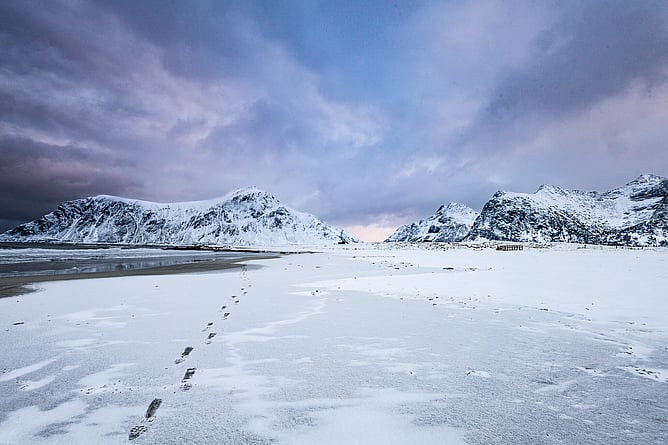
Sunrise footsteps in the snow on Skagsanden Beach, Lofoten Islands, Norway
Lesson one: Sometimes you’re already doing it right
One of the most unexpected things I got from the course was validation.
You spend so much time working in your own creative bubble that it’s easy to assume you're missing something. Some secret camera setting. Some mysterious compositional trick that everyone else learned somewhere along the way or in photography school.
Turns out… I wasn’t doing it wrong. Take that imposter syndrome!
A lot of the feedback during the week confirmed that many of the instincts I already use such as composition, framing, noticing subtle details; are actually working really well.
This was reassuring and mildly inconvenient because I had mentally prepared for at least one dramatic “You’ve been doing this completely backwards, let's correct it” moment.
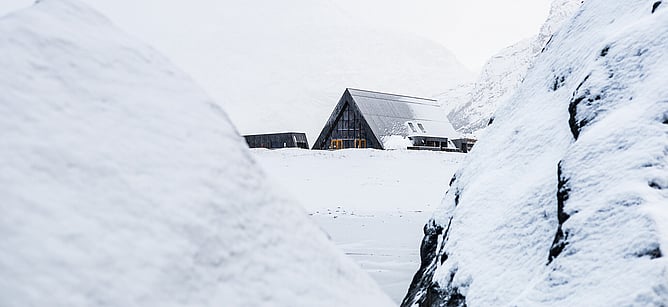
Repetition. Skagsanden Beach, Lofoten Islands, Norway
Lesson two: Angles matter
We spent a lot of time exploring how small shifts in position completely change a photograph.
Step left and zoom with your legs.
Crouch down.
Move closer to the foreground.
Wait for that little snow cloud to pass by and the light to shift.
Landscape photography is often portrayed as standing somewhere scenic and pressing the shutter button.
In reality it’s more like a slow-motion game of creative hide-and-seek with rocks, leading lines, reflections, and balance.
The difference between a nice photo and an interesting one is often just a few steps in another direction.
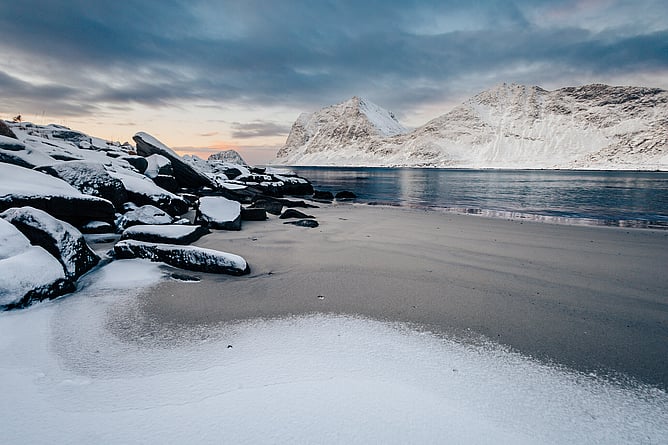
Transition of snow to sand. Vik Strand, Lofoten Islands, Norway
Lesson three: My eye for detail is apparently a superpower
One thing that became very obvious during the course is that my brain is constantly scanning for detail.
Not just the big obvious scenery, but the textures and shapes that quietly hold a composition together.
The curve of a shoreline.
Footprints in the snow making patterns in the foreground.
A line of rocks leading your eye toward the mountains.
The same attention to detail that makes me slightly unbearable when aligning text boxes in design work turns out to be incredibly useful in photography too.
Who knew.
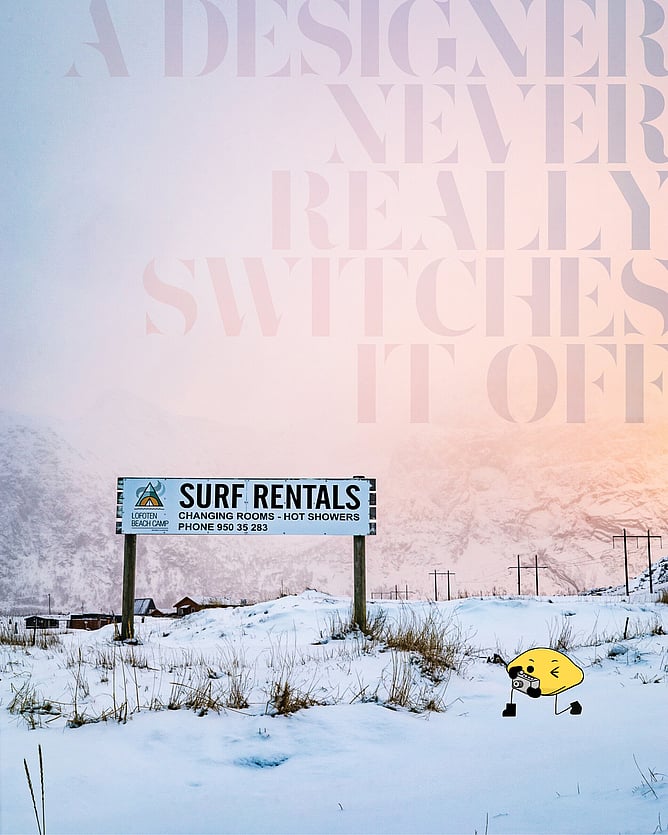
Dreamy surf. Skagsanden Beach, Lofoten Islands, Norway
Lesson four: I don’t just see photos — I see layouts
Another realization: my design background heavily influences how I shoot. Without even thinking about it, my brain often defaults to portrait orientation.
Not because the mountains are taller than they are wide (although in Lofoten they often are), but because somewhere in the back of my mind I’m already thinking about how the image might be used.
Where would typography sit?
Where can illustrations or branding be added?
Is there enough breathing room?
Will this work in a layout?
I’m instinctively looking for:
clean negative space
balanced colour palettes
simplicity in composition
Basically my brain is quietly designing a poster or a publication while I’m taking the photo.
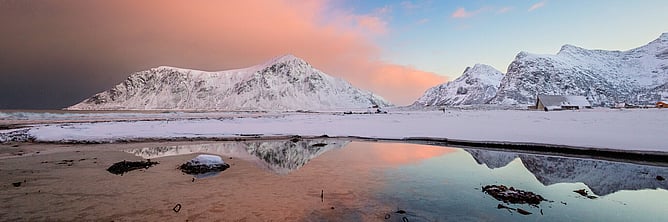
Sunrise at Skagsanden Beach, Lofoten Islands, Norway
Lesson five: Simplicity is powerful
When you’re surrounded by some of the most dramatic and dreamy scenery in the world, the temptation is to include everything.
Mountains.
Ocean.
Sky.
Cabins.
Clouds.
That interesting rock.
Possibly a passing moose.
But the strongest images often came from simplifying. Removing distractions, letting the landscape breathe and focusing on one subject.
Design principles and photography principles overlap far more than I expected. Whether you're designing a website or photographing a fjord at –10°C good composition is good composition.
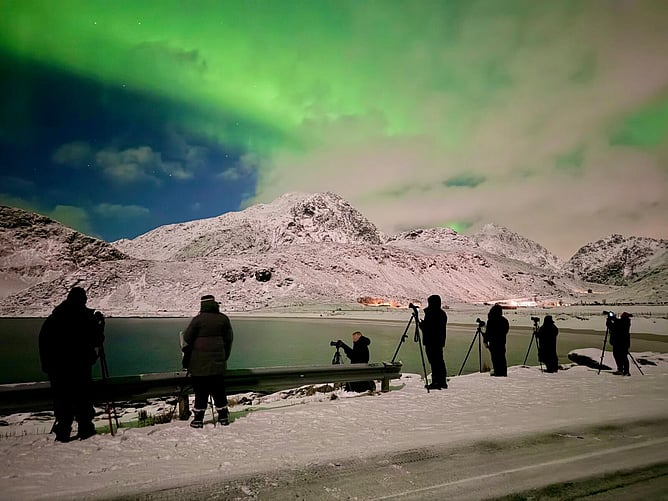
A 'click' of photographers under the Arctic sky at Uttakliev Beach. Photo by Jason Woolard.
The unexpected bonus: Helping other people see
One of the nicest surprises of the week was realising my creative eye was helpful to others on the course. Sometimes spotting a foreground, sometimes suggesting a slightly different angle or sometimes just noticing a line in the landscape.
Creativity is funny like that. The more perspectives you share, the stronger everyone’s work becomes. I found plenty of perspectives and new angles from other people on the course too.
Yes, I learned some technical things.
Yes, I learned new approaches to composition and even post production techniques.
Yes, I confirmed that I looked ridiculous in a woolen hat with ear flaps but I thanked the powers that be that I had it.
Sometimes though, the most valuable thing a course can give you isn’t a brand new skill. It’s the confidence that the way you already see the world is actually pretty powerful. Even if you wear three pairs of woolen socks and your toes are still frozen while you're doing it.